
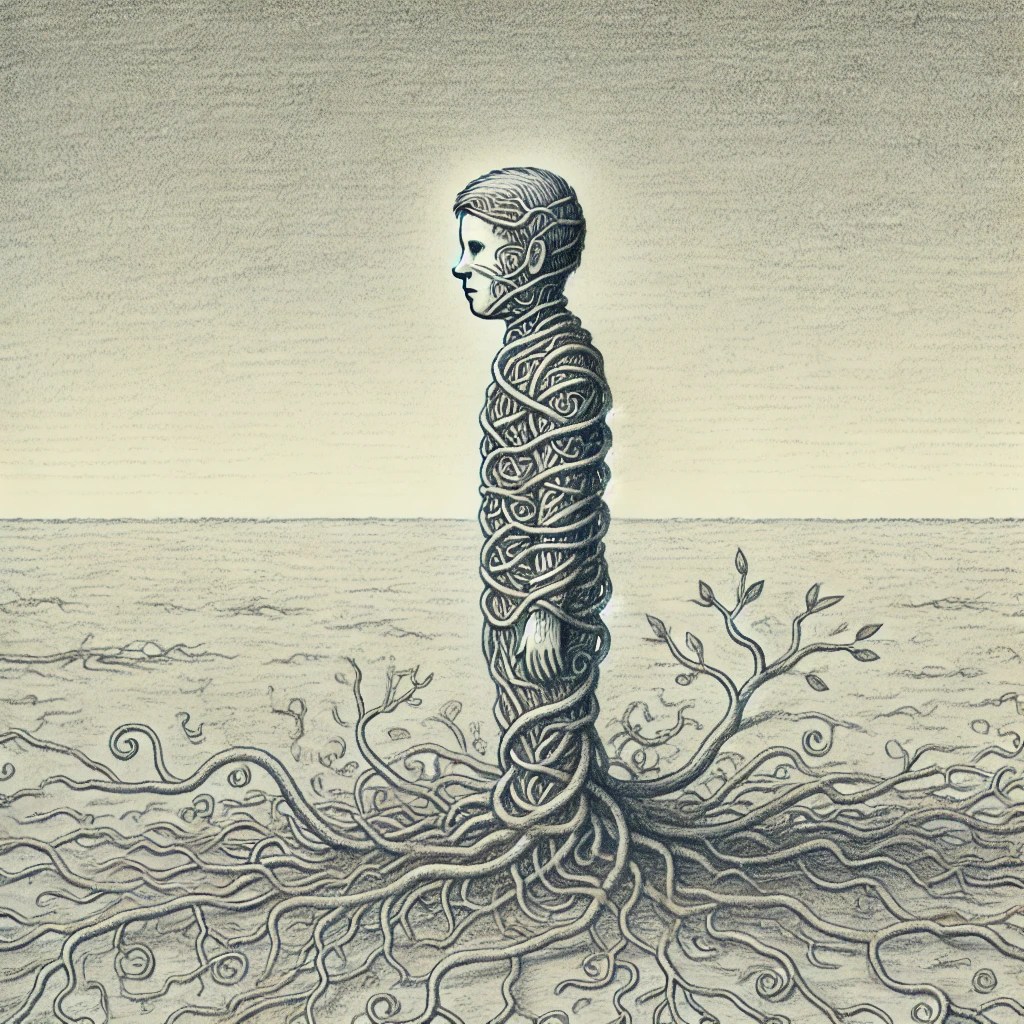
In light of Trump’s recent attempt to end birthright citizenship in America, I wanted to share a piece I wrote for last year’s [fjúžn] magazine. The theme of this edition was “roots.” I shared my thoughts on identity, culture, nationality, and citizenship law. Below is the English version, but if you would like to read the Slovak version, click the link below. While you’re there, have a look at some of the other great stories from migrants around the world. Enjoy!
Tangled Up in Roots
Where are you from? I’ve been asked this question my entire adult life. I moved away from my hometown as a teenager, and I always appeared like a fish out of water wherever I lived—whether here or in America.
Most people asking this question just want to know a bit about me, while others want a chance to speak about my home state or country. However, there is a small group that is searching for a deeper answer. For these people, one’s hometown is less important than the individual’s cultural heritage—their “roots.” This isn’t a totally novel phenomenon, but I feel that this surging interest in identity is different.
In an increasingly globalized cultural landscape (the monoculture, if you will), identity has lost its form—its borders. Individualism has replaced tradition, community, and a collective identity. This has led to a sense of loss and alienation. A desperation has set in, so now people are going to great lengths to find their “roots.”
Capitalism to the Rescue
Lately, science and capitalism have stepped in to solve the identity crisis. This has come in the form of DNA ancestry services and countless television programs exploring ancestry. People mail vials of their own saliva from their cloistered homes, hoping to discover a long-lost royal bloodline or, at the very least, living relatives in their “true” home. Meanwhile, on television, celebrities weep and extol the virtues of their newly discovered, long-dead relatives.
Finding a hidden family history can give people a sense of belonging and lead to a reunion of sorts. Rich and vibrant cultures suddenly reveal themselves, broadening one’s horizons and giving life to the often-dreary modern world. Some will take the opportunity to pursue a new path in life and connect with real people in their ancestral “homeland.” However, for most, this excitement quickly fades away.
Learning that one’s relatives come from the Netherlands and Slovakia does not magically imbue one with the ability to make clogs or play the fujara, and taking part in foreign cultural practices does not have the same emotional resonance that it does for the local population. For most, discovering one’s “roots” amounts to reading lines of code in their DNA. At best, that can only alert one to potential genetic diseases. At worst, it strengthens convictions of genetic, ethnic, and national superiority.
Division and the Law
In the minds of the general public, when it comes to defining nationality, race, and culture, there are bright lines between “us” and “them.” This way of thinking emerges in racist and exclusionary legislation. It is at the root of many inequities because, among other things, it favors the principle of jus sanguinis, or right of blood, in citizenship law. These laws ensure automatic citizenship for those born of citizens.
Some countries, like Slovakia, where jus sanguinis is the law of the land, do also allow children of naturalized citizens to have automatic citizenship. However, other countries grant automatic citizenship only to those of “pure blood,” thus requiring a demonstration of lineage—or “roots,” if you will.
In principle, this can sound fair, but in practice, many people find themselves in legal limbo. Take, for example, two guests I interviewed for my podcast Na Slovensku Aj Po Anglicky. Both were foreigners seeking Slovak citizenship.
One had lived in Slovakia for 17 years. He spoke Slovak. He paid taxes. He had Slovak children. He paid a hefty fee to file an application and take a challenging citizenship test.
The other guest had never really heard of Slovakia before discovering his great-grandfather came from here. However, he was entitled to citizenship by descent because of his relationship to the distant relative he had never met. The process isn’t exactly easy for him, but he is not obligated to speak Slovak or even reside in the country.
At the same time, many people born of non-citizens here in Slovakia spend their entire childhood without the rights and protections of citizenship. They are born in Slovakia. They speak Slovak. They attend Slovak schools. They engage in the same cultural practices as their peers. However, unlike their Slovak peers, these children could potentially be deported anytime their parents lose their legal right to live in Slovakia. Only once these children of migrants become adults can they officially apply for citizenship—just as the foreigner in the podcast did.
The Supreme Cultural Authority
This legal doctrine effectively decides who is worthy of calling themselves Slovak. However, it only takes a casual reading of the news to discover that the legal designation of “Slovak” is wholly different from the cultural understanding. Case in point:
If one day I am successful in gaining Slovak citizenship, can I then call myself Slovak? If I wear the traditional kroj, will it be anything more than just cosplay? Certainly, it would be absurd for me to claim it as my own. This is plain to see.
From the beginning of human civilization to today, people across the world—including Slovaks—have been engaged in culture wars. This fight to establish what is authentic, traditional, and correct is evidence that culture is not a monolith. It is an ever-changing human response to a time and environment. Calling someone or something Slovak, therefore, is to use an imperfect descriptor. It may generally work today, but who knows about tomorrow?
That brings me back to the question of my origin. How do I answer, “Where are you from?” Is it sufficient to say America? Do I talk about my few Native ancestors, or do I go back to that rainy island in the Atlantic? What about my Slovak-American children? Where are their roots? Are their Native American ancestors more relevant to their lives today than their Austro-Hungarian ancestors? These roots are a tangled mess! Or, perhaps, our irrational desire to categorize is the problem.
In the Global Context
Migration is a behavior that is older than our species. As we became homo sapiens, we inhabited faraway lands and developed ways of being that suited those environments. This is culture. As our environment changed, so did our culture. This uniquely human adaptability was only possible through the cooperation of people across vast distances of time and space. To me, unlike an isolated family or ethnic history, this most closely resembles roots.
A tree’s roots burrow deep into the soil to drink in the water and nutrients carried there by roaming clouds and long-decayed organisms. They rely on the interconnectedness of ecosystems and a variety of dissimilar species. The major and minor branches of the roots travel in many directions, searching for their own sources of sustenance, but they all serve the tree itself.
When our societies focus on one branch of our “roots,” we lose sight of the entire human civilization it supports. Perhaps the emerging global society does not represent a loss of culture or identity. If viewed with a hopeful eye, it can be seen as an opportunity to meet new global challenges with the resilience and ingenuity that is only achievable with shared effort.
To this point, culture was exclusive. By losing it, one was left alone. But in a new paradigm of global cooperation and a fusion of cultures and knowledge, we can forget old notions of exclusive, regional identities and begin the work of improving the entire planet.
 Na Slovensku Aj Po Anglicky
Leave a comment